


Chanthaburi Gem Market
22 Sep 2026
0 Comments

By Rishabh Malpani, Gems By Dynamic
The global trade in precious gemstones is often romanticized.
We picture vaulted showrooms in Geneva, quiet display cases in Hong Kong, and perfectly lit stones waiting for their final buyer. But while these places may represent the polished end of the gemstone journey, they are far removed from where much of the real market action begins.
The raw engine of the colored gemstone universe operates on an entirely different frequency.
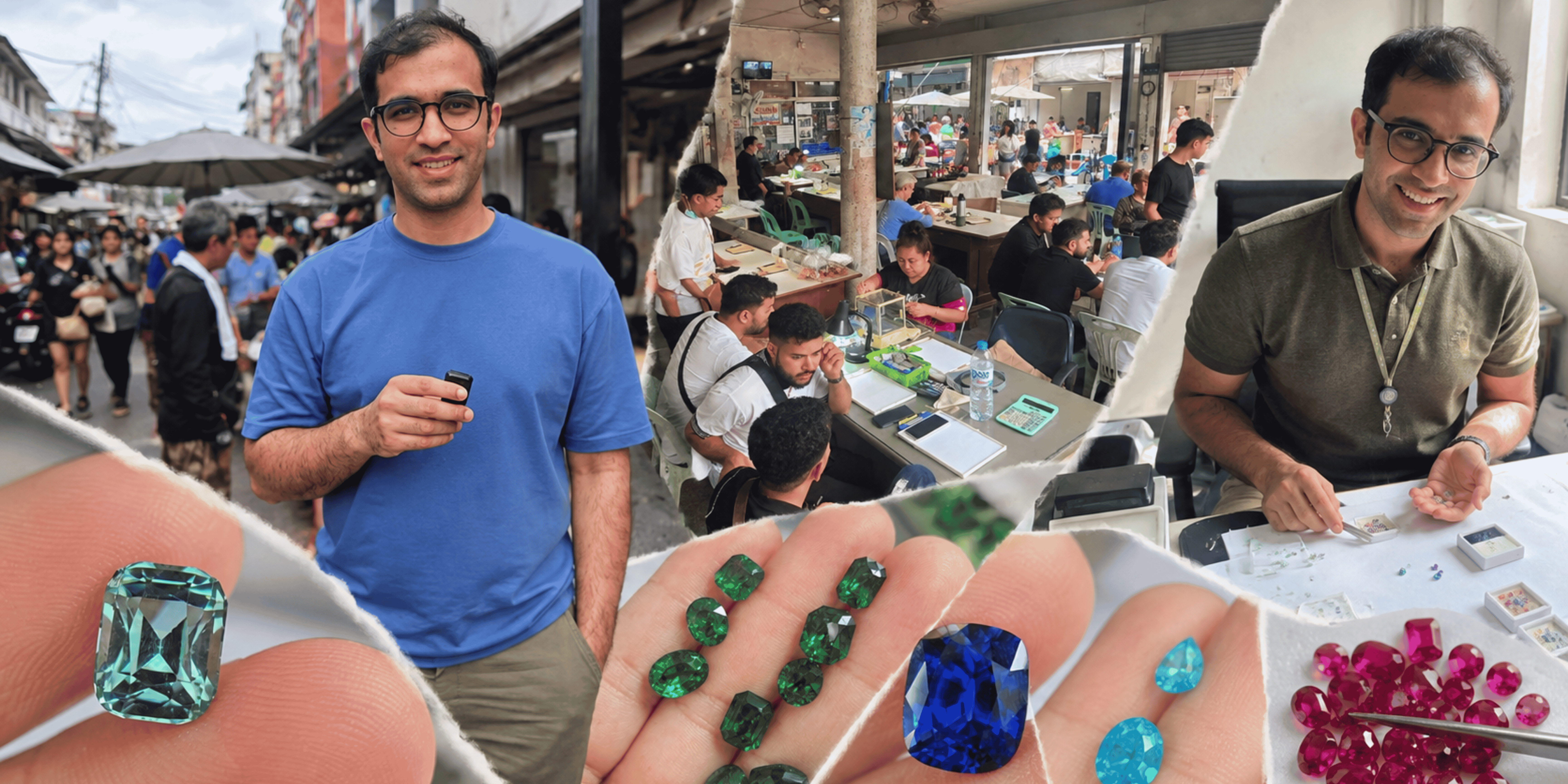
Located roughly 250 kilometers southeast of Bangkok, Chanthaburi, known locally as Talad Ploy, has been the beating heart of the global ruby and sapphire trade for over a century. Every weekend—from Friday morning through Sunday afternoon—the quiet streets around Si Chan Road undergo a remarkable transformation.
What looks like an ordinary neighborhood becomes a fast-moving, open-air gemstone exchange.
Millions of dollars in loose, unmounted gemstones can change hands across wooden tables. There are no grand auction rooms or elaborate displays. Instead, the tools of the trade are remarkably simple: white paper wrappers known as Ploy, calculators, 10x loupes, and cash.
It is raw, fast, and intensely transactional.
Watch a video of Chanthaburi and you’ll see the obvious: crowds moving between tables, tweezers examining stones, loupes held to the eye, and gemstones flashing under the light.
But that is only the surface.
The real story is not simply about the stones. It is about how the capital moves.
Who needs liquidity?
Who is willing to wait?
When does inventory change hands?
And where do pricing mismatches create an opportunity?
These invisible forces shape the market just as much as the gemstones themselves.
Below, we break down three structural market mechanics operating on the floor of Chanthaburi—and how we at Gems by Dynamic leverage them to capture true mine-to-market value.
The global trade in precious gemstones is often romanticized.
We picture vaulted showrooms in Geneva, quiet display cases in Hong Kong, and perfectly lit stones waiting for their final buyer. But while these places may represent the polished end of the gemstone journey, they are far removed from where much of the real market action begins.
The raw engine of the colored gemstone universe operates on an entirely different frequency.
Located roughly 250 kilometers southeast of Bangkok, Chanthaburi, known locally as Talad Ploy, has been the beating heart of the global ruby and sapphire trade for over a century. Every weekend—from Friday morning through Sunday afternoon—the quiet streets around Si Chan Road undergo a remarkable transformation.
What looks like an ordinary neighborhood becomes a fast-moving, open-air gemstone exchange.
Millions of dollars in loose, unmounted gemstones can change hands across wooden tables. There are no grand auction rooms or elaborate displays. Instead, the tools of the trade are remarkably simple: white paper wrappers known as Ploy, calculators, 10x loupes, and cash.
It is raw, fast, and intensely transactional.
Watch a video of Chanthaburi and you’ll see the obvious: crowds moving between tables, tweezers examining stones, loupes held to the eye, and gemstones flashing under the light.
But that is only the surface.
The real story is not simply about the stones. It is about how the capital moves.
Who needs liquidity?
Who is willing to wait?
When does inventory change hands?
And where do pricing mismatches create an opportunity?
These invisible forces shape the market just as much as the gemstones themselves.
Below, we break down three structural market mechanics operating on the floor of Chanthaburi—and how we at Gems by Dynamic leverage them to capture true mine-to-market value.


MECHANIC 1: THE GLOBAL CLEARING HOUSE EFFECT
The Popular Misconception:
First-time visitors often assume that every stone offered on the floor was mined locally or cut in a neighboring Thai factory. While local mines in Chanthaburi and Trat produced historic yields, today's local production is minimal. Yet the infrastructure remains unmatched—with world-class heat treatment, master lapidaries, and dense capital concentrated within the market.
The Trade Reality:
Because Chanthaburi boasts the highest density of active cash buyers in Southeast Asia during the weekend session, it functions as something far more significant than a regional gemstone market.
It functions as a global liquidation clearing house.
Dealers from Bangkok, Sri Lanka, Mozambique, Madagascar, Brazil, and Europe regularly send stagnant inventory to Chanthaburi. These are stones that may have sat in overseas vaults for 6 to 18 months without moving.
In the wholesale trade, sitting on $200,000 worth of slow-moving stock ties up working capital that could otherwise be used to acquire fresh rough directly from the mines. When international dealers require immediate cash liquidity, they send parcels to Chanthaburi brokers to cash out rapidly.
The Sourcing Advantage:
• Inventory Diversity: You can inspect fresh Tanzanian Spinels, Sri Lankan Ceylon Sapphires, and Afghan Tourmalines on the exact same table.
• Motivated Sellers: Goods brought into the market specifically for rapid liquidation are priced to move. A disciplined buyer sitting at the table can acquire top-tier material well below standard international wholesale benchmarks.
The Popular Misconception:
First-time visitors often assume that every stone offered on the floor was mined locally or cut in a neighboring Thai factory. While local mines in Chanthaburi and Trat produced historic yields, today's local production is minimal. Yet the infrastructure remains unmatched—with world-class heat treatment, master lapidaries, and dense capital concentrated within the market.
The Trade Reality:
Because Chanthaburi boasts the highest density of active cash buyers in Southeast Asia during the weekend session, it functions as something far more significant than a regional gemstone market.
It functions as a global liquidation clearing house.
Dealers from Bangkok, Sri Lanka, Mozambique, Madagascar, Brazil, and Europe regularly send stagnant inventory to Chanthaburi. These are stones that may have sat in overseas vaults for 6 to 18 months without moving.
In the wholesale trade, sitting on $200,000 worth of slow-moving stock ties up working capital that could otherwise be used to acquire fresh rough directly from the mines. When international dealers require immediate cash liquidity, they send parcels to Chanthaburi brokers to cash out rapidly.
The Sourcing Advantage:
• Inventory Diversity: You can inspect fresh Tanzanian Spinels, Sri Lankan Ceylon Sapphires, and Afghan Tourmalines on the exact same table.
• Motivated Sellers: Goods brought into the market specifically for rapid liquidation are priced to move. A disciplined buyer sitting at the table can acquire top-tier material well below standard international wholesale benchmarks.


MECHANIC 2: THE WEEKEND CASH-OUT & LIQUIDITY CYCLE
Mastering macroeconomics is only half the equation; winning at the trading table requires mastering micro-timing over the 72-hour weekend session.
FRIDAY: THE WALL OF OPTIMISM
The market opens with high energy. Sellers set high asking prices, refuse aggressive counter-offers, and let prospective buyers walk away, expecting better offers by Saturday.
Attempting deep discounts on Friday is inefficient.
SATURDAY: THE REALIGNMENT PHASE
By Saturday afternoon, unsold parcels begin to accumulate on broker desks. Sellers start analyzing their cash flow against weekly obligations—paying local cutters, settling debts with rough suppliers, or funding travel.
The psychology of the table begins to shift.
SUNDAY: THE CASH-OUT WINDOW
As the market winds down toward 4:00 PM on Sunday, sellers face departure deadlines. Unsold inventory generates zero yield until the following week.
This is when we execute disciplined cash bids:
1. Target high-quality, commercially liquid single stones and matched pairs.
2. Place firm, cash-backed offers well below initial Friday asking prices.
3. As the market approaches closing, owners needing cash velocity regularly accept offers they outright rejected 48 hours earlier.
The result is a fundamental trading principle:
We capture extraordinary savings not by compromising on clarity or color, but by trading liquidity for price.
Mastering macroeconomics is only half the equation; winning at the trading table requires mastering micro-timing over the 72-hour weekend session.
FRIDAY: THE WALL OF OPTIMISM
The market opens with high energy. Sellers set high asking prices, refuse aggressive counter-offers, and let prospective buyers walk away, expecting better offers by Saturday.
Attempting deep discounts on Friday is inefficient.
SATURDAY: THE REALIGNMENT PHASE
By Saturday afternoon, unsold parcels begin to accumulate on broker desks. Sellers start analyzing their cash flow against weekly obligations—paying local cutters, settling debts with rough suppliers, or funding travel.
The psychology of the table begins to shift.
SUNDAY: THE CASH-OUT WINDOW
As the market winds down toward 4:00 PM on Sunday, sellers face departure deadlines. Unsold inventory generates zero yield until the following week.
This is when we execute disciplined cash bids:
1. Target high-quality, commercially liquid single stones and matched pairs.
2. Place firm, cash-backed offers well below initial Friday asking prices.
3. As the market approaches closing, owners needing cash velocity regularly accept offers they outright rejected 48 hours earlier.
The result is a fundamental trading principle:
We capture extraordinary savings not by compromising on clarity or color, but by trading liquidity for price.


MECHANIC 3: CAPITALIZING ON MARKET MISMATCHES
The third mechanic is about exploiting category mismatches. Every major gemstone hub develops its own specific bias. Jaipur specializes in emeralds and commercial beads, while Chanthaburi is overwhelmingly a Ruby and Sapphire market.
That specialization creates an opportunity.
Because 85% to 90% of buyers on Si Chan Road hunt exclusively for Corundum, non-corundum species can face almost zero buyer competition.
In other words, sometimes the best opportunity on the table is the stone that everyone else came to ignore.
CASE STUDY: THE 1.83CT CERTIFIED LAGOON TOURMALINE
During a recent trip, a broker brought over a breathtaking 1.83-carat Rectangular Cushion Lagoon Tourmaline. It possessed electric sea-foam green and cyan blue tones, eye-clean clarity, a precision cut, and a full lab certificate.
In a specialized tourmaline market or international trade show, a certified piece of this caliber would carry a heavy premium.
But sitting in Chanthaburi, surrounded predominantly by sapphire buyers, it became a classic example of a market mismatch.
The stone had not changed.
The quality had not changed.
The certificate had not changed.
Only the competitive landscape had changed.
Recognizing the lack of competing demand, we negotiated effectively, securing the certified piece for well below the market price.
By recognizing what the broader market ignored, we were able to acquire an exceptional piece at a fraction of its standard international wholesale value.
The third mechanic is about exploiting category mismatches. Every major gemstone hub develops its own specific bias. Jaipur specializes in emeralds and commercial beads, while Chanthaburi is overwhelmingly a Ruby and Sapphire market.
That specialization creates an opportunity.
Because 85% to 90% of buyers on Si Chan Road hunt exclusively for Corundum, non-corundum species can face almost zero buyer competition.
In other words, sometimes the best opportunity on the table is the stone that everyone else came to ignore.
CASE STUDY: THE 1.83CT CERTIFIED LAGOON TOURMALINE
During a recent trip, a broker brought over a breathtaking 1.83-carat Rectangular Cushion Lagoon Tourmaline. It possessed electric sea-foam green and cyan blue tones, eye-clean clarity, a precision cut, and a full lab certificate.
In a specialized tourmaline market or international trade show, a certified piece of this caliber would carry a heavy premium.
But sitting in Chanthaburi, surrounded predominantly by sapphire buyers, it became a classic example of a market mismatch.
The stone had not changed.
The quality had not changed.
The certificate had not changed.
Only the competitive landscape had changed.
Recognizing the lack of competing demand, we negotiated effectively, securing the certified piece for well below the market price.
By recognizing what the broader market ignored, we were able to acquire an exceptional piece at a fraction of its standard international wholesale value.


THE "GEMS BY DYNAMIC" ADVANTAGE
We do not buy inventory from digital spreadsheets or simply pay through third-party markup chains.
We physically travel to sourcing hubs.
We evaluate real-time market shifts.
We identify where demand is concentrated—and where it isn't.
Then, we apply four decades of inherited trade knowledge to every deal.
Because true mine-to-market value isn't created by simply finding a beautiful gemstone.
It is created by knowing where to look, when to buy, and when the market is looking the other way.
We do not buy inventory from digital spreadsheets or simply pay through third-party markup chains.
We physically travel to sourcing hubs.
We evaluate real-time market shifts.
We identify where demand is concentrated—and where it isn't.
Then, we apply four decades of inherited trade knowledge to every deal.
Because true mine-to-market value isn't created by simply finding a beautiful gemstone.
It is created by knowing where to look, when to buy, and when the market is looking the other way.